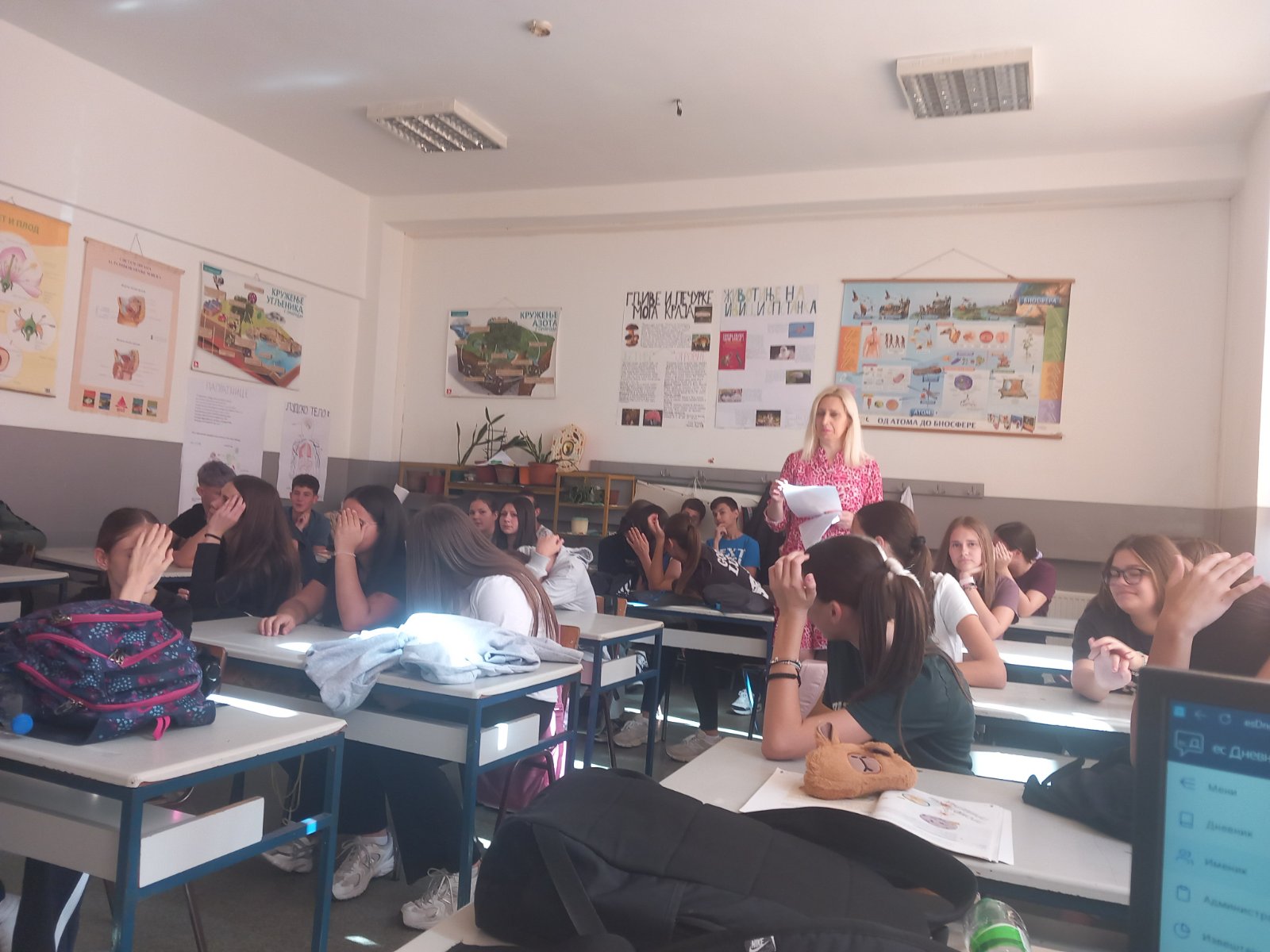
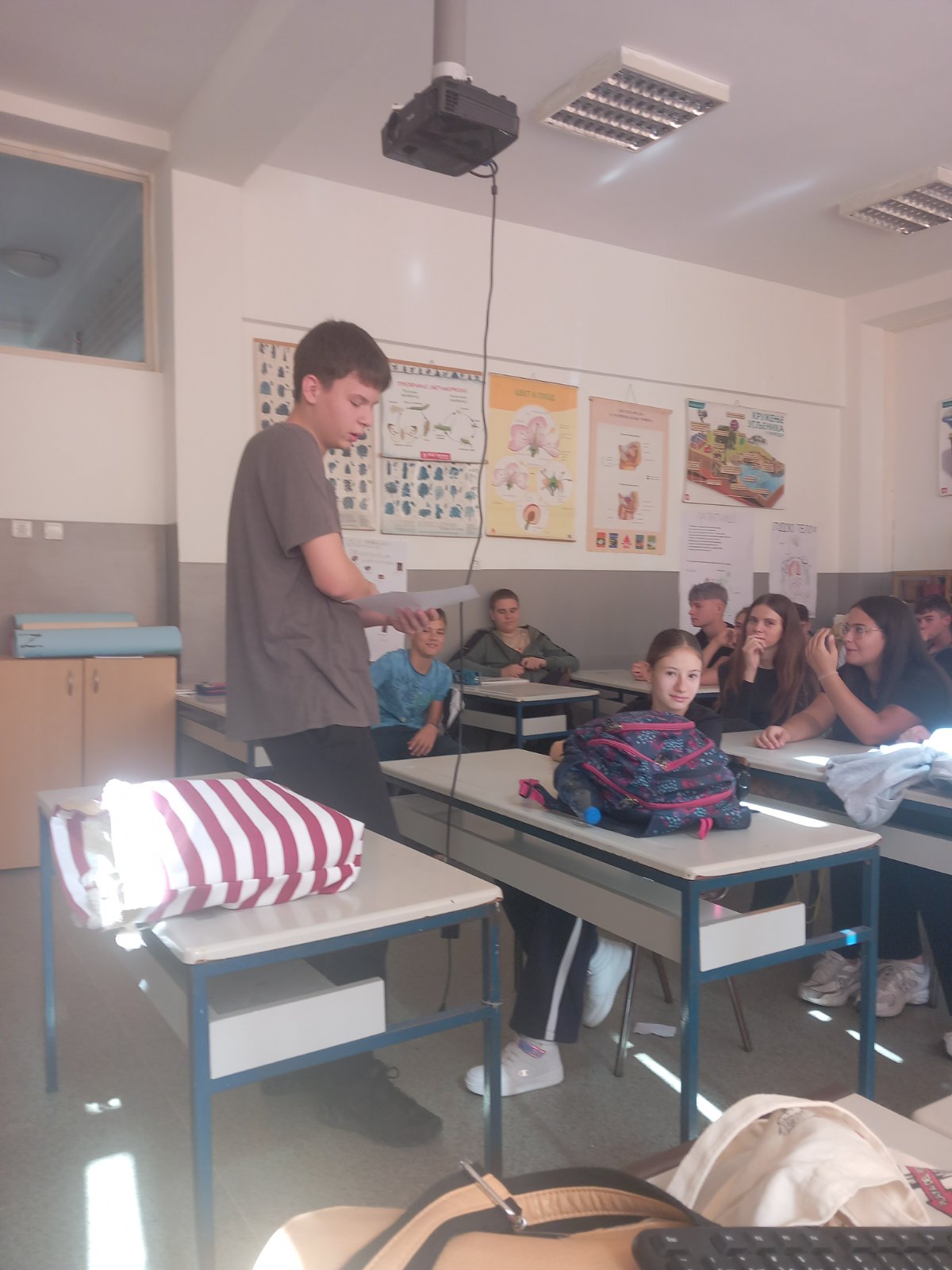
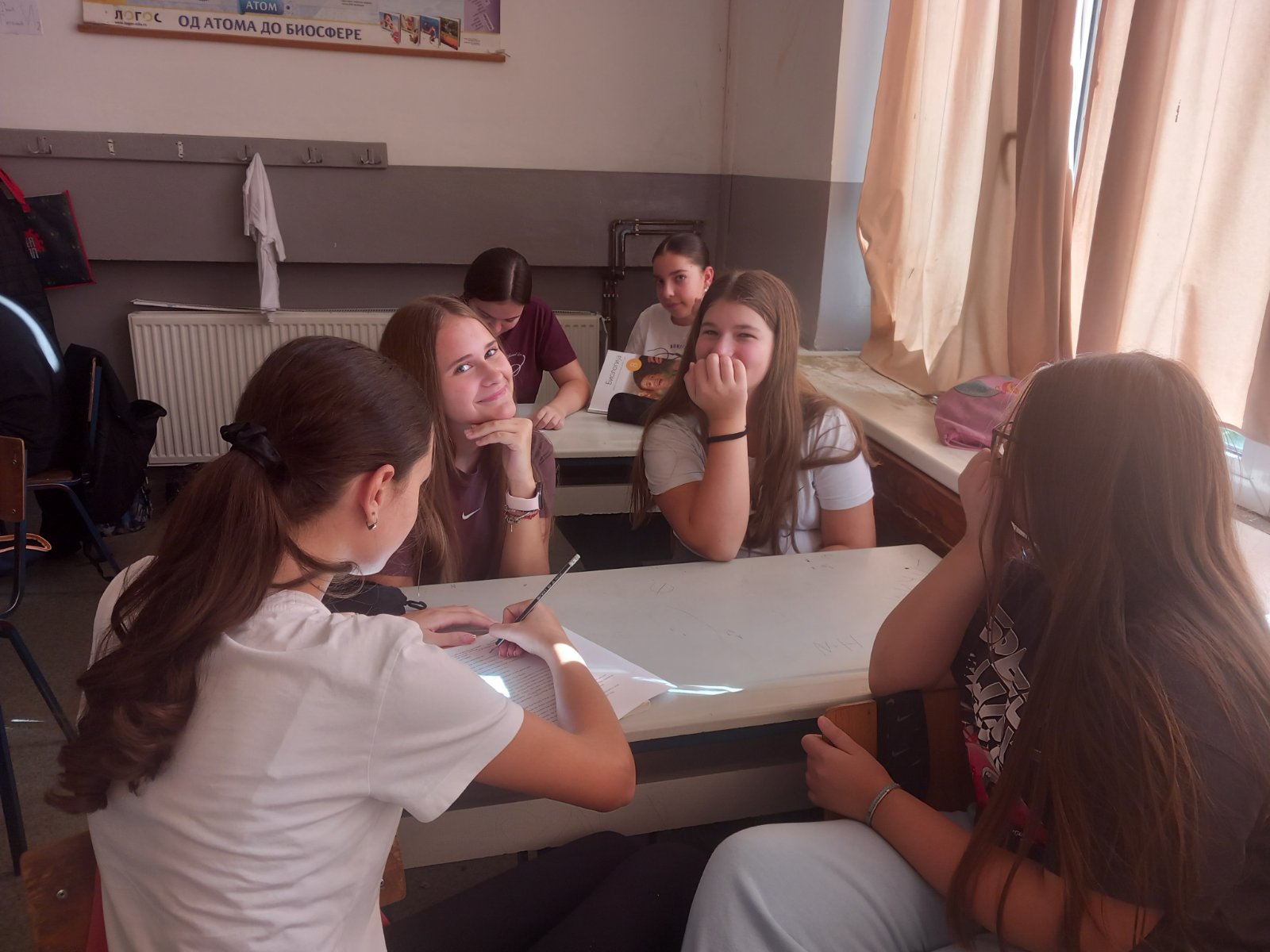
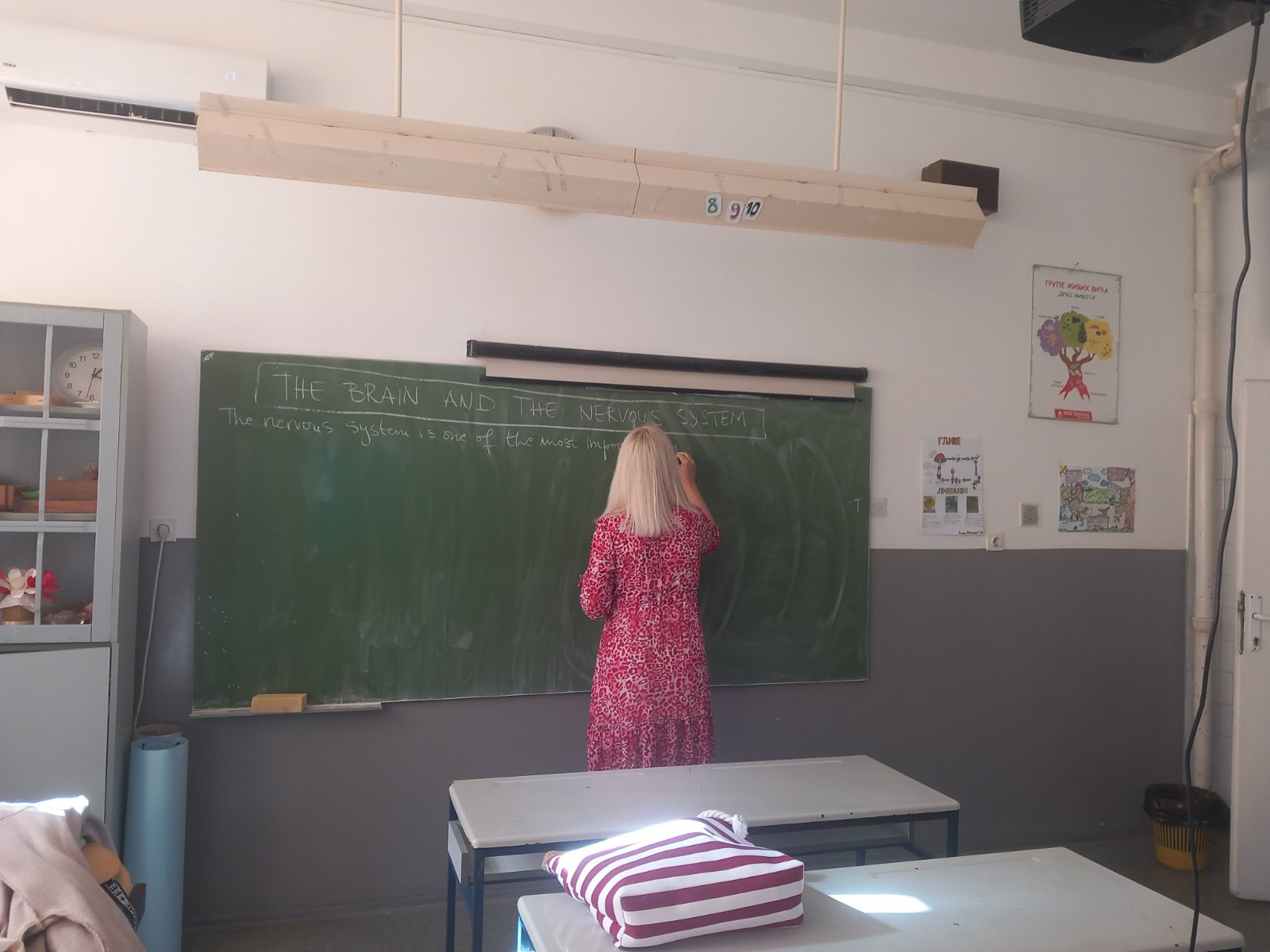
Поводом Европског дана језика ученици одељења 8-2 и 8-3 заједно са својим наставницама биологије Маријом Поповић и енглеског језика Сањом Симић де Граф имали су интегративан час биологије и енглеског језика кроз занимљив вид проширивања методичких могућности два предмета у циљу успешнијег усвајања градива оба предмета на мало другачији начин. Наставна тема која се обрађује у осмом разреду у оквиру предмета биологија ,,Мозак и нервни систем“ послужила је као материјал за утврђивање граматике енглеског језика, углавном глаголских времена која се тренутно утврђују у оквиру редовних наставних јединица. Додатно је утврђен вокабулар и морфологија, као и модални глаголи. Кроз различита времена и превођење реченица на задату тему ученици су истовремено кроз активноучење утврђивали градиво оба предмета.
Ученици су били подељени по мешовитим групама. Пример задатака који су реализовани на овом интегративном часу:
The Brain and the Nervous System
The nervous system is one of the most important systems in the human body. It controls and coordinates our body and helps us react to the world around us. It also allows us to think, learn, remember, feel and move.
The nervous system is divided into two main parts: the central nervous system and the peripheral nervous system. The central nervous system consists of the brain and spinal cord. The peripheral nervous system consists of nerves that connect the brain and spinal cord with the rest of the body.
The brain is the control center of the body. It is protected by the skull. The brain has several important parts.
The cerebrum is the largest part of the brain. It controls thinking, memory, learning, speech and voluntary movements. It is divided into two halves called hemispheres.
The cerebellum, or the small brain, helps control balance, coordination and precise movements.
The brainstem connects the brain with the spinal cord. It controls important functions such as breathing, heartbeat and swallowing.
The spinal cord is a long bundle of nerves that connects the brain with the rest of the body. It also controls some quick reactions called reflexes.
The basic cells of the nervous system are called neurons. Neurons send electrical and chemical signals through the body. They help the brain receive information and send instructions to different parts of the body.
The nervous system is very important because it helps us sense, think, move, learn and respond to our environment.
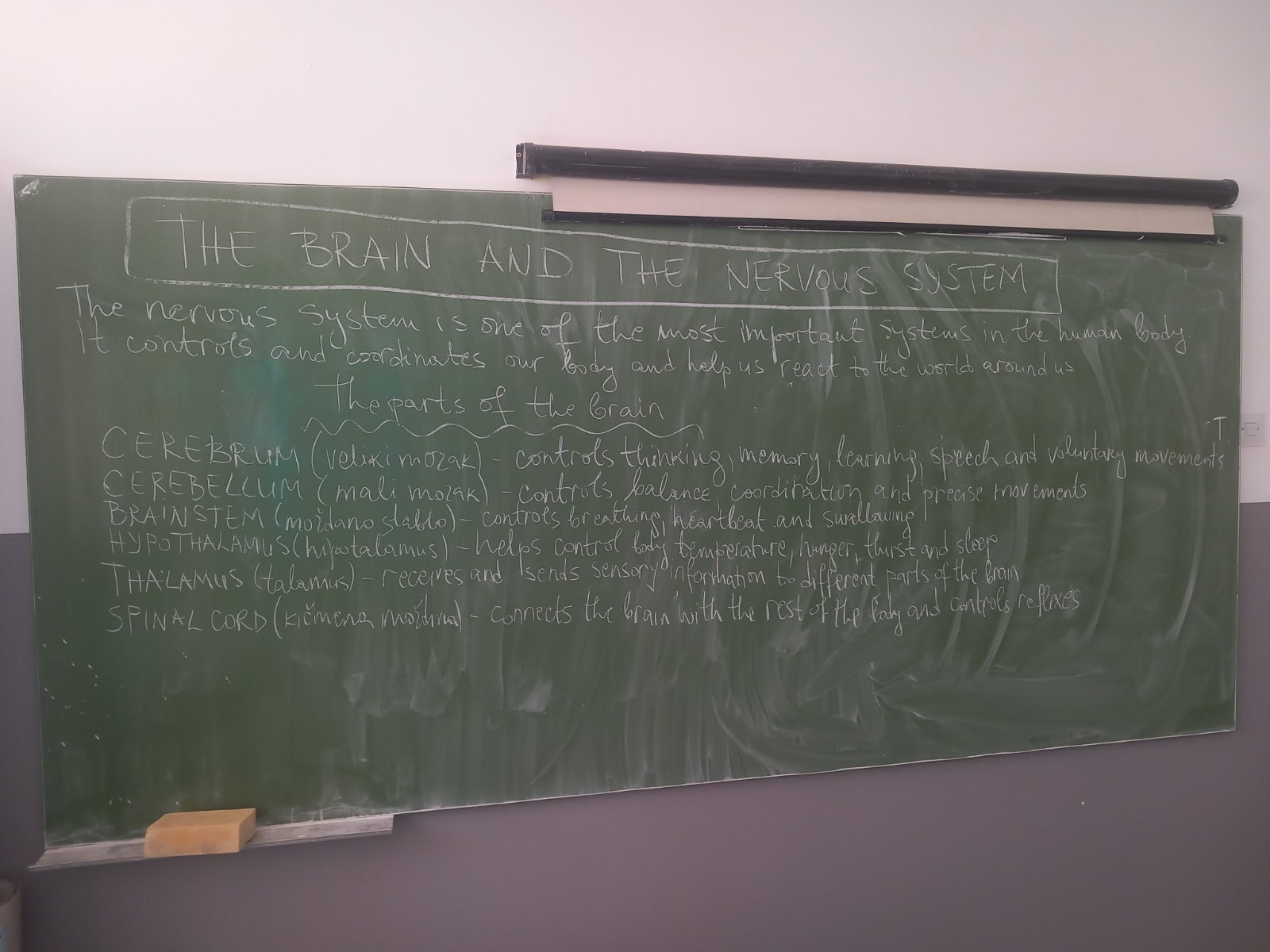
THE PARTS OF THE BRAIN
Cerebrum – veliki mozak; controls thinking, memory, learning, speech and voluntary movements.
Cerebellum – mali mozak; controls balance, coordination and precise movements.
Brainstem – moždano stablo; controls breathing, heartbeat and swallowing.
Hypothalamus – hipotalamus; helps control body temperature, hunger, thirst and sleep.
Thalamus – talamus; receives and sends sensory information to different parts of the brain.
Spinal cord – kičmena moždina; connects the brain with the rest of the body and controls reflexes.
Izaberi: Past Simple, Past Continuous, Present Perfect ili Past Perfect.
1.The scientist _______ (study) the brain for many years.
2.Yesterday, the doctor _______ (examine) the patient.
3.While the doctor _______ (examine) the patient, the phone rang.
4.The patient felt better because he _______ (take) his medicine.
5.Scientists _______ (discover) many important facts about the brain.
6.When I arrived, the lesson _______ already _______ (start).
7.The doctor _______ (check) my reflexes last week.
8.While the scientist _______ (work), he found an interesting result.
9.We _______ (learn) about the nervous system since September.
10.After the doctor _______ (finish) the examination, he talked to the patient.
Prevedi na engleski
1. Naučnici su otkrili mnogo toga o mozgu.
2. Doktor je juče pregledao pacijenta.
3. Doktor je pregledavao pacijenta kada je zazvonio telefon.
4. Pacijent se osećao bolje jer je uzeo lek.
5.Učimo o nervnom sistemu od septembra.
6. Kada je doktor stigao, pacijent je već otišao.
7. Naučnici su proučavali mozak mnogo godina.
8. Nakon što je naučnik završio eksperiment, napisao je izveštaj.
Stavi glagol iz zagrade u Past Simple.
1.Yesterday, the doctor _______ (examine) the patient’s nervous system.
2.The brain _______ (receive) information from the body.
3.The neurons _______ (send) signals to the brain.
4.The doctor _______ (check) the patient’s reflexes.
5.The patient _______ (feel) pain in his arm.
6.The scientist _______ (study) the human brain.
7.The cerebellum _______ (help) the patient keep his balance.
Izaberi Past Simple ili Past Continuous
1.While the doctor examined / was examining the patient, the patient felt nervous.
2.The scientist was studying / studied the brain when he found something interesting.
3.The neurons were sending / sent signals when the experiment started.
4.Yesterday, the doctor checked / was checking my reflexes.
5.While the patient was sleeping / slept, his nervous system continued to work.
6.The doctor was talking / talked to the patient when the phone rang.
Napravi odrične rečenice
Example:
The doctor examined the patient.
The doctor didn’t examine the patient.
1.The scientist studied the brain.
2. The doctor checked the reflexes.
3.The patient felt pain.
4.The neurons sent signals.
Napravi pitanja
Example:
The doctor examined the patient.
Did the doctor examine the patient?
1-The scientist studied the brain.
2.The doctor checked the patient’s reflexes.
3. The patient felt dizzy.
4.The neurons sent signals.
Prevedi na engleski
1.Doktor je pregledao pacijenta.
2. Naučnik je proučavao mozak.
3. Neuroni su slali signale.
4. Pacijent je osećao bol.
5. Doktor je proveravao reflekse kada je pacijent pao.
6.Dok je naučnik proučavao mozak, pronašao je nešto zanimljivo.
Present Perfect – dopuni glagole
Stavi glagol u Present Perfect.
1.Scientists _______ _______ (discover) many things about the human brain.
2The doctor _______ _______ (examine) the patient’s nervous system.
3.Scientists _______ _______ (study) neurons for many years.
4The patient _______ _______ (feel) better.
5.Doctors _______ _______ (learn) a lot about the brain.
6.The scientist _______ _______ (find) an interesting result.
7We _______ _______ (study) the nervous system at school.
8.The doctors _______ _______ (test) his reflexes.
Present Perfect ili Past Simple?
Izaberi pravilno vreme.
1Scientists discovered / have discovered many things about the brain.
2.The doctor examined / has examined the patient yesterday.
3.I have learned / learned a lot about neurons this year.
4The scientist found / has found an interesting result last week.
5.Doctors have studied / studied the nervous system for many years.
6.She visited / has visited the doctor two days ago
Stavi glagol u Past Perfect.
1.The doctor arrived after the patient _______ _______ (leave).
2The scientist started the experiment after he _______ _______ (prepare) everything.
3.The doctor knew that the patient _______ _______ (have) problems with his reflexes.
4.The patient felt better because he _______ _______ (take) his medicine.
5. The scientists made a discovery after they _______ _______ (study) the brain for years.
6The doctor checked the patient after he _______ _______ (finish) the examination.
Past Simple ili Past Perfect?
1.When the doctor arrived, the patient had left / left.
2.After the scientist had finished / finished the experiment, he wrote a report.
3.The doctor examined / had examined the patient after he had spoken to him.
4.When we arrived at the laboratory, the scientists had started / started the experiment.
5.The patient felt better because he had taken / took his medicine.
6.After the doctor had checked / checked the reflexes, he wrote the results.
Present Simple – Put the verbs in brackets into the correct form.
1.The nervous system _______ (control) many activities in the body.
2.The brain _______ (help) us think and learn.
3.Neurons _______ (send) signals through the body.
4.The cerebrum _______ (control) memory and speech.
5.The cerebellum _______ (help) us keep our balance.
6.The brainstem _______ (connect) the brain with the spinal cord.
7.The spinal cord _______ (control) some reflexes.
8.The thalamus _______ (receive) sensory information.
9.Nerves _______ (connect) the brain with the rest of the body.
10.The nervous system _______ (allow) us to feel and move.
Complete the sentences with can or can’t.
1.The brain _______ control many activities.
2.The nervous system _______ help us think and learn.
3.Neurons _______ send signals through the body.
4.The cerebellum _______ help us keep our balance.
5.The brain _______ communicate with the rest of the body.
6.The nervous system _______ work without the brain and spinal cord.
HAVE GOT / HAS GOT
Complete the sentences with have got or has got.
1.The brain _______ several important parts.
2.The nervous system _______ two main parts.
3.Neurons _______ important functions.
4.The cerebrum _______ two hemispheres.
5.The body _______ a nervous system.
6.The brain and spinal cord _______ many nerves connected to them.
Passive Voice – Complete the sentences.
Example:
The brain _______ by the skull. (protect)
The brain is protected by the skull.
1.The nervous system _______ into two main parts. (divide)
2.The brain _______ by the skull. (protect)
3.The cerebrum _______ into two halves. (divide)
4.The basic cells of the nervous system _______ neurons. (call)
5.The two halves of the cerebrum _______ hemispheres. (call)
6.The nervous system _______ up of different parts. (make)
Translate into English.
1.Nervni sistem kontroliše telo.
2.Veliki mozak kontroliše razmišljanje i memoriju.
3.Mali mozak kontroliše ravnotežu.
4.Moždano stablo kontroliše disanje i rad srca.
5.Kičmena moždina povezuje mozak sa ostatkom tela.
6.Neuroni šalju signale kroz telo.
7.Mozak je zaštićen lobanjom.
…